
There are thousands of trading bots out there promising the moon. Most are garbage — either scams, over-optimized backtests that never work live, or strategies so simple that any edge they had got competed away years ago. So, is the Marty Bot any different?
Instead of hype and marketing claims, let's look at actual performance data from 2025, understand what makes the strategy work, and be honest about what it doesn't do well.
What is Marty? (The Strategy in Plain English)
Marty is a mean-reversion bot designed for the Nasdaq (NQ) and S&P 500 (ES) futures markets. Mean reversion is the statistical tendency for prices that have moved significantly away from their historical average to eventually return toward that average.
The underlying logic: markets spend most of their time in equilibrium — buyers and sellers roughly agree on value, and price oscillates in a range. When price gets pushed too far in one direction (usually by short-term panic or euphoria), it tends to snap back. Marty identifies these "stretched" conditions statistically and enters a trade in the direction of expected reversion.
This is not a gut-feel strategy. The "too far" threshold is calculated using volatility models — specifically, how far price has moved relative to its recent average true range and statistical standard deviation bands. When price exceeds X standard deviations from its short-term mean, the bot activates. It doesn't care about news, doesn't have opinions about the economy, and doesn't have emotions about what happened in yesterday's session.
Marty thrives in ranging or choppy markets, which represent approximately 70% of all trading days historically. In grinding, sideways price action — the type that frustrates most manual traders — Marty is in its element, grinding out small wins consistently. See the full Marty Bot strategy overview for the complete methodology.
Template Review: Risk and Assumptions
Trade This Systematically
Stop reading. Start executing.
Join 500+ traders using YMI's automated bots, daily KPLs, and AI trade plans, no guesswork required.
Before using any Marty template, review the market regime, costs, slippage assumptions, drawdown behavior, and SIM results. Historical samples are context, not a promise of future performance.
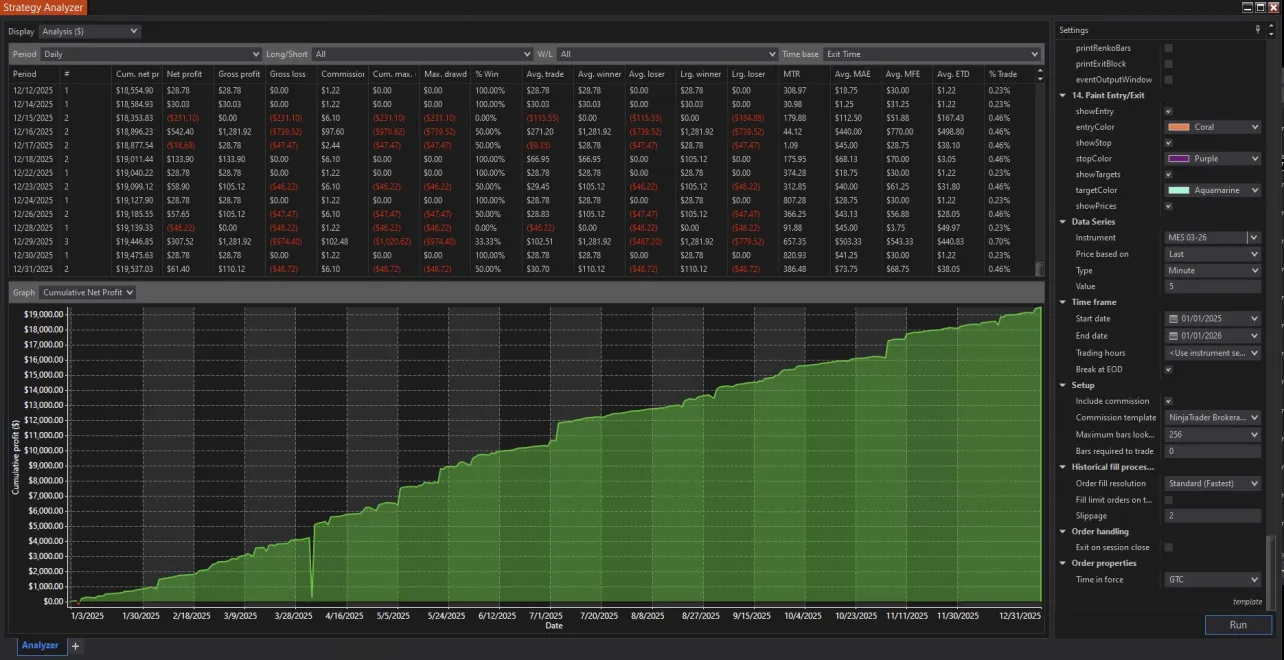
- Regime fit: slow, range-bound conditions only
- Required checks: costs, slippage, drawdown, and current-market behavior
- Deployment rule: validate in SIM before live use
- Review cadence: monitor logs, fills, and rule adherence after each session
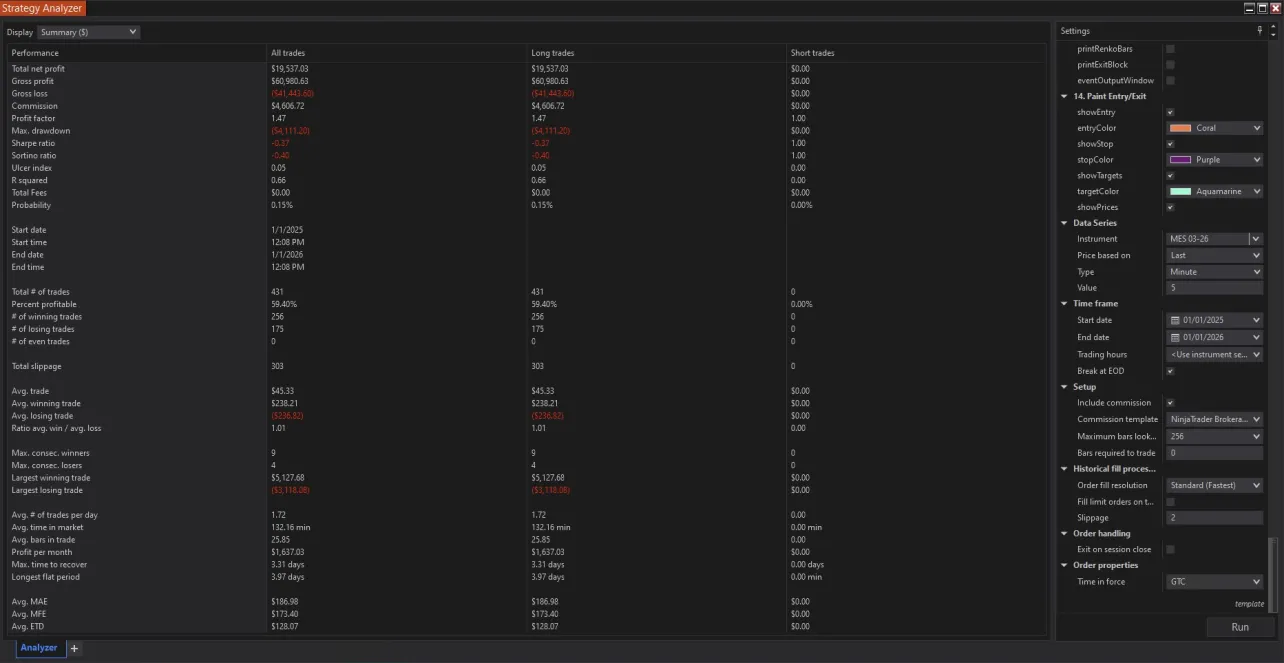
Let's put these numbers in context. A profit factor of 1.47 is solid — not spectacular, but well above the 1.0 break-even line and firmly in the range where the edge is real and sustainable. The 59% win rate means you're right more than you're wrong, which keeps the equity curve smooth. The max drawdown of $4,111 on a system generating $19,537 annually means the drawdown-to-annual-return ratio is approximately 21% — excellent for an automated system.
The Steady Gains Template: Why This Config Specifically
Marty has multiple configuration templates designed for different goals. The "Steady Gains" template is optimized for consistency over maximum return — which makes it ideal for two use cases:
- Prop firm evaluations: The tight daily loss limit and profit target walk-away feature allow you to chip away at evaluation targets without risking the trailing drawdown violation. Members have used this template to pass dozens of Apex 50k and 100k evaluations. See our Apex evaluation guide for the specific settings.
- Live funded accounts: Once you have prop firm capital, the priority shifts from hitting a profit target to protecting the funded account while following payout rules. Steady Gains is calibrated for controlled trade frequency, defined stops, and reviewable execution.
The template uses conservative position sizing (1-2 MES contracts), a defined maximum daily loss that auto-stops the bot, and a daily profit target that shuts down trading once the goal is met. The philosophy is: take the day's profit and protect it. Come back tomorrow.
When Marty Struggles: The Honest Assessment
Mean reversion strategies have a structural weakness: they underperform in strong, sustained trending markets. If the S&P 500 is in a relentless uptrend, every "it's moved too far" signal might just be the next step in the trend. Marty is fading moves that don't revert — and losing those trades.
Specifically, Marty struggles during:
- Trend days (approximately 30% of sessions): Days where the market opens and moves in one direction all day without meaningful reversion. Marty will typically have 2-4 losses on these days as it keeps fading the trend until regime filters kick in and shut it down.
- FOMC and major economic releases: High-impact news creates sharp, one-directional moves that blow through mean-reversion logic. The Steady Gains template includes a news filter that pauses Marty around scheduled events.
- Extended bear markets with high volatility: The 2022 bear market (VIX consistently 25-40) was challenging for mean-reversion systems because the "normal range" kept expanding. Drawdown-to-recovery cycles lengthened.
This is why we don't run Marty in isolation. The built-in regime filters detect when the market is trending and reduce position size or stop trading entirely. And for trend days specifically, the KPL Bot (which runs trend-following and breakout logic) is designed to complement Marty — you're running mean reversion in choppy conditions and trend-following in trending conditions.
Who Marty Is For (And Who It Isn't)
Marty is right for you if:
- You want a systematic trading tool with defined monitoring and review requirements
- You're working toward or have passed a prop firm evaluation
- You want to add a systematic, automated strategy to your existing trading
- You're comfortable with a 59% win rate and occasional drawdown periods knowing the math works out over large sample sizes
Marty is NOT right for you if:
- You want home runs — large individual winners with infrequent trades
- You're not willing to follow the written operating rules through normal losing days
- You expect it to work perfectly in every market condition
- You don't understand mean reversion well enough to know when the strategy is working correctly vs. when something is genuinely wrong
Verdict: A Strategy That Still Requires Review
Marty's mean reversion approach should be evaluated through documented configuration, market-regime fit, SIM validation, account-level risk limits, and post-session review. No live or historical sample makes future performance predictable.
It's not a "get rich quick" button. It is a rules-based execution tool that can help reduce discretionary mistakes when the trader understands the strategy, monitors the account, and knows when to pause it.
Ready to run Marty yourself?
- Marty Bot Strategy Overview — the full mean-reversion methodology explained
- Marty Bot Technical Specs — parameters, templates, and deployment guide
- Pro Trader Membership — includes Marty Bot, KPL Bot, 12+ templates, and structured setup support
About the Author

Founder, Young Money Investments · Quant Trader
Cameron trades ES, NQ, and futures across multiple market cycles. He founded Young Money Investments to teach systematic, data-driven trading and manages Magnum Opus Capital. His work emphasizes documented rules, risk controls, and review over outcome promises.
Free, No Credit Card
Get Daily KPLs in Your Inbox
AI-generated Key Price Levels for ES & NQ, delivered every trading morning. Join 500+ traders who start their session with a plan.
Risk Disclosure & Disclaimer
Educational Purposes Only: The content provided in this blog is for educational and informational purposes only. It does not constitute financial, investment, or trading advice. Young Money Investments is not a registered investment advisor, broker-dealer, or financial analyst.
Risk Warning: Trading futures, forex, stocks, and cryptocurrencies involves a substantial risk of loss and is not suitable for every investor. The valuation of futures, stocks, and options may fluctuate, and as a result, clients may lose more than their original investment.
CFTC Rule 4.41 - Hypothetical or Simulated Performance Results: Certain results (including backtests mentioned in these articles) are hypothetical. Hypothetical performance results have many inherent limitations. No representation is being made that any account will or is likely to achieve profits or losses similar to those shown. In fact, there are frequently sharp differences between hypothetical performance results and the actual results subsequently achieved by any particular trading program.
Testimonials: Testimonials appearing on this website may not be representative of other clients or customers and is not a guarantee of future performance or success.